AbCellera Announces Positive Top-Line Phase 2 Clinical Trial Results for ABCL635, Demonstrating Significant Reduction in Frequency and Severity of Vasomotor Symptoms and a Favorable Tolerability Profile

Idag, 13:00
Idag, 13:00
AbCellera (Nasdaq: ABCL) today announced positive top-line results from the Phase 2 portion of its Phase 1/2 clinical trial evaluating ABCL635, an investigational neurokinin 3 receptor (NK3R) antagonist antibody. ABCL635 is being developed as a non-hormonal, long-acting, subcutaneous treatment for moderate-to-severe vasomotor symptoms (VMSM-S), commonly known as hot flashes, due to menopause. The study met the primary efficacy endpoints achieving statistically significant reductions in both frequency and severity of VMSM-S at week 4 compared to placebo after a single dose. ABCL635 was also observed to significantly improve sleep and patient global impression of change (PGI-C).
This press release features multimedia. View the full release here: https://www.businesswire.com/news/home/20260810931321/en/
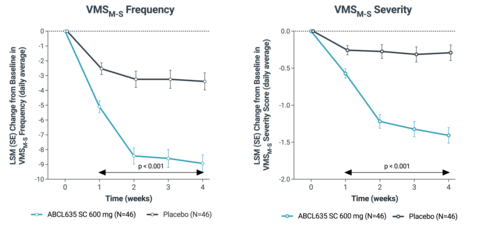
Figure 1. Mean change from baseline in daily average frequency and severity of moderate-to-severe vasomotor symptoms (VMS (M-S)) over four weeks. Least squares mean (LSM) change (±SE) in VMS (M-S) daily average frequency (left) and severity score (right) for participants treated with subcutaneous ABCL635 600 mg (N=46, light blue) compared to placebo (N=46, dark grey) through week 4. Statistical significance was maintained from week 1 through week 4 (p 0.001).
“The four-week data for the Phase 2 study of ABCL635 demonstrate a new efficacy benchmark for the reduction of hot flashes both in frequency and severity, as well as improvements in sleep. These symptoms can profoundly impact women's daily lives when left unmanaged,” said Dr. JoAnn V. Pinkerton, M.D., Women’s Midlife Professor of Obstetrics and Gynecology at the University of Virginia School of Medicine. “If validated in Phase 3, ABCL635 could offer a new treatment option with a more convenient dosing regimen and potentially less toxicity.”
The randomized, double-blind, placebo-controlled, multicenter Phase 2 portion of the ABCL635 study enrolled 92 postmenopausal women experiencing a mean of approximately 10 moderate or severe hot flashes per day. The participants were randomized 1:1 to receive either a single subcutaneous 600 mg dose of ABCL635 or placebo.
ABCL635 reduced VMSM-S frequency compared to placebo, with an 8.8 mean reduction in the number of moderate and severe events per day from baseline at week 4 (Day 29) compared to 3.5, showing a mean placebo-adjusted treatment difference of 5.3 (p<0.001). The mean percent reduction at week 4 for VMSM-S frequency was 83% for the ABCL635 treatment group versus a 33% reduction for placebo, leading to a mean placebo-adjusted treatment difference of 50%.
ABCL635 also resulted in improvement in VMSM-S severity compared to placebo, with a mean reduction of 1.4 points at week 4 compared to 0.3, and a mean placebo-adjusted treatment difference of 1.1 (p<0.001). The mean percent reduction in VMSM-S severity from baseline to week 4 was 58% in the ABCL635 group compared to 12% in the placebo group, leading to a mean placebo-adjusted treatment difference of 46%.
Meaningful improvements were also observed in patient sleep scores and patient global impression of change.
ABCL635 was well-tolerated throughout the four-week treatment period with no serious adverse events, severe adverse events, or adverse events that led to study discontinuation. The most common adverse events in the ABCL635 treatment group and higher than placebo wereheadache, fatigue, and injection site reaction.
“These positive results represent a significant milestone for women’s health and for AbCellera,” said Sarah Noonberg, M.D., Ph.D., Chief Medical Officer of AbCellera. “By successfully targeting the NK3 receptor with an antibody, we have demonstrated potential best-in-class vasomotor symptom relief over four weeks with a single subcutaneous dose. These data indicate that ABCL635 could offer menopausal women a well-tolerated, long-acting treatment that has the potential to markedly improve their quality of life.”
AbCellera will hold an investor conference call at 4:30 a.m. Pacific Time (7:30 a.m. Eastern Time) today, August 10, 2026.
A live audio webcast of the investor conference may be accessed through a link that will be posted on AbCellera’s Investor Relations website. A replay will be available through the same link following the conference call.
About ABCL635
ABCL635 is a potential best-in-class investigational antibody drug for the non-hormonal, long-acting treatment of moderate-to-severe VMS, commonly known as hot flashes, due to menopause. ABCL635 specifically targets NK3R, a clinically validated G protein-coupled receptor (GPCR) expressed on KNDy neurons in the infundibular nucleus of the hypothalamus. ABCL635 is AbCellera’s first pipeline program from the GPCR and ion channel platform to advance into the clinic, in July 2025. Additional details are available at www.abcellera.com/pipeline.
The Phase 2 trial of ABCL635 (NCT07118891) is a multicenter, randomized, double-blind, placebo-controlled trial in postmenopausal women with moderate-to-severe VMS due to menopause evaluating safety and efficacy of ABCL635.
About VMS
Hot flashes and night sweats, known as VMS, are the most common menopausal symptoms, impacting up to 80% of women. The majority rate their VMS as moderate to severe, characterized by intense feelings of heat that lead to sweating, chills, and interrupted sleep. VMS are the most frequent reason for seeking medical care for menopause. VMS can persist for many years after the final menstrual period, and the impact is felt across many aspects of everyday life, including sleep, concentration, energy and mood, work, social activities, and relationships. It is estimated that approximately 12 million women in the US experience moderate-to-severe VMS, of which more than six million seek treatment.
About AbCellera Biologics Inc.
AbCellera (Nasdaq: ABCL) is a clinical-stage biotechnology company focused on discovering and developing first-in-class antibody-based medicines in the areas of endocrinology, women’s health, immunology, oncology, and more. For more information, please visit www.abcellera.com.
AbCellera Forward-looking Statements
This document contains forward-looking statements, including statements made pursuant to the safe harbor provisions of the Private Securities Litigation Reform Act of 1995. The forward-looking statements are based on management’s beliefs and assumptions and on information currently available to management. All statements contained in this document other than statements of historical fact are forward-looking statements, including statements regarding the safety and efficacy profile and therapeutic potential of, and our ability to develop, commercialize and achieve market acceptance of, ABCL635. In some cases, you can identify forward-looking statements by the words “may,” “will,” “could,” “would,” “should,” “expect,” “intend,” “plan,” “anticipate,” “believe,” “estimate,” “predict,” “project,” “potential,” “continue,” “ongoing” or the negative of these terms or other comparable terminology, although not all forward-looking statements contain these words.
These statements involve risks, uncertainties and other factors that may cause actual results, levels of activity, performance, or achievements to be materially different from the information expressed or implied by these forward-looking statements. Significant risks for ABCL635 include that (i) ABCL635 is an investigational agent subject to potential negative safety and efficacy findings in future clinical studies (notwithstanding positive findings in earlier preclinical and clinical studies); (ii) adverse results can unexpectedly occur at any stage prior to regulatory approval; (iii) data reported from ongoing clinical trials are necessarily interim data only and the final results will change; and (iv) the timing of clinical trials and availability of clinical data may be delayed or unsuccessful due to regulatory delays, slower than anticipated patient enrollment, or other reasons. These risks, uncertainties, other factors, and definition of our business metrics are described under “Risk Factors,” “Management’s Discussion and Analysis of Financial Condition and Results of Operations” and elsewhere in the documents we file with the Securities and Exchange Commission from time to time. We caution you that forward-looking statements are based on a combination of facts and factors currently known by us and our projections of the future, about which we cannot be certain. As a result, the forward-looking statements may not prove to be accurate. The forward-looking statements in this document represent our views as of the date hereof. We undertake no obligation to update any forward-looking statements for any reason, except as required by law.
View source version on businesswire.com: https://www.businesswire.com/news/home/20260810931321/en/
Idag, 13:00
AbCellera (Nasdaq: ABCL) today announced positive top-line results from the Phase 2 portion of its Phase 1/2 clinical trial evaluating ABCL635, an investigational neurokinin 3 receptor (NK3R) antagonist antibody. ABCL635 is being developed as a non-hormonal, long-acting, subcutaneous treatment for moderate-to-severe vasomotor symptoms (VMSM-S), commonly known as hot flashes, due to menopause. The study met the primary efficacy endpoints achieving statistically significant reductions in both frequency and severity of VMSM-S at week 4 compared to placebo after a single dose. ABCL635 was also observed to significantly improve sleep and patient global impression of change (PGI-C).
This press release features multimedia. View the full release here: https://www.businesswire.com/news/home/20260810931321/en/
Figure 1. Mean change from baseline in daily average frequency and severity of moderate-to-severe vasomotor symptoms (VMS (M-S)) over four weeks. Least squares mean (LSM) change (±SE) in VMS (M-S) daily average frequency (left) and severity score (right) for participants treated with subcutaneous ABCL635 600 mg (N=46, light blue) compared to placebo (N=46, dark grey) through week 4. Statistical significance was maintained from week 1 through week 4 (p 0.001).
“The four-week data for the Phase 2 study of ABCL635 demonstrate a new efficacy benchmark for the reduction of hot flashes both in frequency and severity, as well as improvements in sleep. These symptoms can profoundly impact women's daily lives when left unmanaged,” said Dr. JoAnn V. Pinkerton, M.D., Women’s Midlife Professor of Obstetrics and Gynecology at the University of Virginia School of Medicine. “If validated in Phase 3, ABCL635 could offer a new treatment option with a more convenient dosing regimen and potentially less toxicity.”
The randomized, double-blind, placebo-controlled, multicenter Phase 2 portion of the ABCL635 study enrolled 92 postmenopausal women experiencing a mean of approximately 10 moderate or severe hot flashes per day. The participants were randomized 1:1 to receive either a single subcutaneous 600 mg dose of ABCL635 or placebo.
ABCL635 reduced VMSM-S frequency compared to placebo, with an 8.8 mean reduction in the number of moderate and severe events per day from baseline at week 4 (Day 29) compared to 3.5, showing a mean placebo-adjusted treatment difference of 5.3 (p<0.001). The mean percent reduction at week 4 for VMSM-S frequency was 83% for the ABCL635 treatment group versus a 33% reduction for placebo, leading to a mean placebo-adjusted treatment difference of 50%.
ABCL635 also resulted in improvement in VMSM-S severity compared to placebo, with a mean reduction of 1.4 points at week 4 compared to 0.3, and a mean placebo-adjusted treatment difference of 1.1 (p<0.001). The mean percent reduction in VMSM-S severity from baseline to week 4 was 58% in the ABCL635 group compared to 12% in the placebo group, leading to a mean placebo-adjusted treatment difference of 46%.
Meaningful improvements were also observed in patient sleep scores and patient global impression of change.
ABCL635 was well-tolerated throughout the four-week treatment period with no serious adverse events, severe adverse events, or adverse events that led to study discontinuation. The most common adverse events in the ABCL635 treatment group and higher than placebo wereheadache, fatigue, and injection site reaction.
“These positive results represent a significant milestone for women’s health and for AbCellera,” said Sarah Noonberg, M.D., Ph.D., Chief Medical Officer of AbCellera. “By successfully targeting the NK3 receptor with an antibody, we have demonstrated potential best-in-class vasomotor symptom relief over four weeks with a single subcutaneous dose. These data indicate that ABCL635 could offer menopausal women a well-tolerated, long-acting treatment that has the potential to markedly improve their quality of life.”
AbCellera will hold an investor conference call at 4:30 a.m. Pacific Time (7:30 a.m. Eastern Time) today, August 10, 2026.
A live audio webcast of the investor conference may be accessed through a link that will be posted on AbCellera’s Investor Relations website. A replay will be available through the same link following the conference call.
About ABCL635
ABCL635 is a potential best-in-class investigational antibody drug for the non-hormonal, long-acting treatment of moderate-to-severe VMS, commonly known as hot flashes, due to menopause. ABCL635 specifically targets NK3R, a clinically validated G protein-coupled receptor (GPCR) expressed on KNDy neurons in the infundibular nucleus of the hypothalamus. ABCL635 is AbCellera’s first pipeline program from the GPCR and ion channel platform to advance into the clinic, in July 2025. Additional details are available at www.abcellera.com/pipeline.
The Phase 2 trial of ABCL635 (NCT07118891) is a multicenter, randomized, double-blind, placebo-controlled trial in postmenopausal women with moderate-to-severe VMS due to menopause evaluating safety and efficacy of ABCL635.
About VMS
Hot flashes and night sweats, known as VMS, are the most common menopausal symptoms, impacting up to 80% of women. The majority rate their VMS as moderate to severe, characterized by intense feelings of heat that lead to sweating, chills, and interrupted sleep. VMS are the most frequent reason for seeking medical care for menopause. VMS can persist for many years after the final menstrual period, and the impact is felt across many aspects of everyday life, including sleep, concentration, energy and mood, work, social activities, and relationships. It is estimated that approximately 12 million women in the US experience moderate-to-severe VMS, of which more than six million seek treatment.
About AbCellera Biologics Inc.
AbCellera (Nasdaq: ABCL) is a clinical-stage biotechnology company focused on discovering and developing first-in-class antibody-based medicines in the areas of endocrinology, women’s health, immunology, oncology, and more. For more information, please visit www.abcellera.com.
AbCellera Forward-looking Statements
This document contains forward-looking statements, including statements made pursuant to the safe harbor provisions of the Private Securities Litigation Reform Act of 1995. The forward-looking statements are based on management’s beliefs and assumptions and on information currently available to management. All statements contained in this document other than statements of historical fact are forward-looking statements, including statements regarding the safety and efficacy profile and therapeutic potential of, and our ability to develop, commercialize and achieve market acceptance of, ABCL635. In some cases, you can identify forward-looking statements by the words “may,” “will,” “could,” “would,” “should,” “expect,” “intend,” “plan,” “anticipate,” “believe,” “estimate,” “predict,” “project,” “potential,” “continue,” “ongoing” or the negative of these terms or other comparable terminology, although not all forward-looking statements contain these words.
These statements involve risks, uncertainties and other factors that may cause actual results, levels of activity, performance, or achievements to be materially different from the information expressed or implied by these forward-looking statements. Significant risks for ABCL635 include that (i) ABCL635 is an investigational agent subject to potential negative safety and efficacy findings in future clinical studies (notwithstanding positive findings in earlier preclinical and clinical studies); (ii) adverse results can unexpectedly occur at any stage prior to regulatory approval; (iii) data reported from ongoing clinical trials are necessarily interim data only and the final results will change; and (iv) the timing of clinical trials and availability of clinical data may be delayed or unsuccessful due to regulatory delays, slower than anticipated patient enrollment, or other reasons. These risks, uncertainties, other factors, and definition of our business metrics are described under “Risk Factors,” “Management’s Discussion and Analysis of Financial Condition and Results of Operations” and elsewhere in the documents we file with the Securities and Exchange Commission from time to time. We caution you that forward-looking statements are based on a combination of facts and factors currently known by us and our projections of the future, about which we cannot be certain. As a result, the forward-looking statements may not prove to be accurate. The forward-looking statements in this document represent our views as of the date hereof. We undertake no obligation to update any forward-looking statements for any reason, except as required by law.
View source version on businesswire.com: https://www.businesswire.com/news/home/20260810931321/en/
Fonder
Fonder
1 DAG %
Senast
OMX Stockholm 30
−0,24%
(14:40)
OMX Stockholm 30
1 DAG %
Senast
3 304,72


