Aduro and ECOCE Complete Phase 1 Feedstock Mapping, Advance Mexico Plastics Collaboration to HCT Testing

Idag, 14:00
Idag, 14:00
Selected streams from Mexico’s flexible and multilayer plastic waste, a category estimated at approximately 1.5 million tonnes annually, advance to HCT testing for circular feedstock evaluation
LONDON, Ontario, July 16, 2026 (GLOBE NEWSWIRE) -- Aduro Clean Technologies Inc. (“Aduro” or the “Company”) (Nasdaq: ADUR) (TSX: ACT) (FSE: 9D5), a clean technology company using the power of chemistry to transform lower-value feedstocks, like waste plastics, heavy bitumen, and renewable oils, into resources for the 21st century, today announced that its collaboration with ECOCE, A.C. (“ECOCE”) has advanced to the next phase following completion of Phase 1 feedstock mapping and stream selection. Selected post-consumer flexible plastic packaging streams in Mexico are now moving into a Hydrochemolytic™ Technology (“HCT”) test campaign to evaluate their conversion into liquid hydrocarbon products for downstream circular plastics applications.
The collaboration, announced in December 2025, is structured as a phased, data-driven evaluation of flexible plastic packaging collected through recovery systems in Mexico. Phase 1 drew on ECOCE’s ongoing national feedstock mapping program, conducted for its member companies, from which the parties completed the selection of candidate material streams for the next stage of work. Led by ECOCE, the mapping identified multiple post-consumer flexible packaging streams and assessed them for estimated availability, collection routes, physical form, contamination profile, and preparation requirements. The work identified candidate streams with sufficient available volume to support an industrially relevant evaluation and with material characteristics that warrant advancement to HCT testing.
Flexible plastic packaging is one of the most difficult material categories to manage within existing recycling systems. These streams can include polyethylene, polypropylene, and multilayer packaging formats, along with inks, adhesives, mixed structures, small formats, and varying levels of contamination. In line with the waste hierarchy, reduction, reuse, and mechanical recycling remain preferred options where they are technically and economically viable. For flexible packaging streams that are not well suited to mechanical or physical recycling, the collaboration is evaluating whether HCT can provide a route to recover hydrocarbon value from these materials and help return them to the plastics value chain.
ECOCE has identified flexible plastic packaging as a major and growing material category in Mexico, with available data indicating that approximately 1.5 million tonnes of flexible plastic packaging are generated annually in the country. Phase 1 has built on that market context by mapping candidate flexible and multilayer plastic packaging waste streams, including material categories, collection routes, geographic sourcing, and indicative contamination levels. The materials mapped through Phase 1 include flexible polypropylene packaging, flexible polyethylene packaging, and multilayer flexible packaging, including common post-consumer formats such as snack and cookie wrappers, grocery and bread bags, seed and grain packaging, pet food packaging, cold-cut and dairy packaging, and resealable pouch formats.
ECOCE’s work with leading food and beverage companies, representing more than 400 brands, gives the collaboration practical relevance to packaging value-chain priorities and the need for credible circularity options for difficult-to-recycle flexible packaging. The objective is to build an evidence-based understanding of how selected flexible packaging streams can move through a circular value chain: from post-consumer collection and characterization, through feedstock preparation and HCT conversion, to liquid hydrocarbon products for evaluation by petrochemical and polymer value chains.
With Phase 1 complete and the next-phase testing program defined, the collaboration now moves into HCT testing of selected material streams. Aduro will begin with lab-scale evaluation to assess how selected Mexican flexible and multilayer plastic waste streams respond to HCT, including processability, product characteristics, yield, residues, contaminant behaviour, and mass balance. As part of this next phase, Adrián Velasco, Director of Flexible Plastic Packaging at ECOCE, will visit Aduro facilities to review the testing pathway, sample requirements, and pilot-scale development program. The visit will help align ECOCE’s knowledge of recovery systems in Mexico with the Company’s technical evaluation process as selected streams move from feedstock mapping into HCT testing. Successful lab-scale results will inform progression to Phase 3 testing on the Next Generation Process (“NGP”) Pilot Plant to support scale-up assessment, customer evaluation, and future commercial analysis.
“Phase 1 has moved this collaboration from a market opportunity into a defined technical feedstock program,” said Ofer Vicus, CEO of Aduro. “ECOCE brings practical insight into how flexible packaging moves through Mexican recovery systems, helping us select representative material streams for HCT testing. The next phase will generate the data that matters for scale-up and economics, including processability, product quality, yield, contaminant behaviour, and the potential value of HCT-derived liquids as circular hydrocarbon feedstocks. This is how Aduro advances commercialization: by connecting real materials, downstream requirements, economic validation, and a clear pathway from lab testing to the NGP Pilot Plant.”
“Flexible plastic packaging is one of the most important material-management challenges in Mexico,” said Adrián Velasco, Director of Flexible Plastic Packaging at ECOCE. “Through this collaboration, ECOCE is helping connect real recovery-system data with the technical work needed to evaluate circular solutions for these materials. My visit to Aduro facilities as the collaboration moves into HCT testing will allow us to review the testing pathway directly, align on sample requirements, and better understand how selected Mexican flexible packaging streams could be evaluated for return to the plastics value chain.”
Results from the next phase will give Aduro and ECOCE the technical and economic evidence to help assess material suitability, product quality, scale-up requirements, and future commercial options for returning difficult-to-recycle flexible packaging to the plastics value chain.
About ECOCE
ECOCE, A.C. is a non-profit civil association in Mexico created and supported by the food and beverage industry to promote the proper management, collection, and recycling of post-consumer packaging waste. ECOCE brings together leading beverage and food companies, representing more than 400 brands, along with strategic allies working to advance circular economy practices for packaging in Mexico.
ECOCE works with industry, government, educational institutions, civil society, and citizens to strengthen recycling culture, support proper separation and recovery of packaging materials, and help direct post-consumer packaging into recycling systems. As ECOCE expands its focus from PET and other established material streams to flexible plastic packaging, it brings practical knowledge of Mexico recovery systems, packaging formats, collection infrastructure, and member-company circularity priorities. For further information, visit www.ecoce.mx.
About Aduro Clean Technologies
Aduro Clean Technologies is a developer of patented water-based technologies to chemically recycle waste plastics; convert heavy crude and bitumen into lighter, more valuable oil; and transform renewable oils into higher-value fuels or renewable chemicals. The Company’s Hydrochemolytic™ technology relies on water as a critical agent in a chemistry platform that operates at relatively low temperatures and cost, a game-changing approach that converts low-value feedstocks into resources for the 21st century. For further information, visit www.adurocleantech.com.
For further information, please contact:
Abe Dyck, Head of Corporate Development / Investor Relations
ir@adurocleantech.com
+1 226 784 8889
Carla Gamboa
Director of Marketing & Communications
cgamboa@ecoce.mx
Forward-Looking Statements
This news release contains forward-looking statements within the meaning of applicable Canadian and U.S. securities laws, including the U.S. Private Securities Litigation Reform Act of 1995. Forward-looking statements in this release include, but are not limited to: statements regarding the collaboration between Aduro and ECOCE; the characterization, selection, and evaluation of Mexican flexible plastic packaging streams; the potential application of Aduro Hydrochemolytic™ Technology to post-consumer flexible plastic packaging; the planned progression from lab-scale testing to potential Next Generation Process Pilot Plant trial runs; the potential generation of product-quality, mass-balance, scale-up, customer evaluation, technical, and commercial assessment data; market demand for circular feedstocks; the potential for HCT-derived hydrocarbon products to support petrochemical and polymer value chains; the potential development of business models or future HCT-based facilities in Mexico; and broader commercialization and market development plans.
Forward-looking statements are based on management current expectations and assumptions, including assumptions regarding: the availability, quality, composition, and suitability of feedstock streams; the ability of ECOCE to provide relevant feedstock information; the ability of Aduro to conduct staged technical testing; the performance of HCT across selected material streams; the scalability of results from lab-scale testing and NGP Pilot Plant operations; the availability of partners, customers, facilities, capital, and regulatory approvals; continued demand for circular feedstocks; and the stability of policy, market, and economic conditions supporting circular plastics. These statements are subject to a number of risks and uncertainties, including, but not limited to: the risk that selected materials may not be suitable for HCT processing; the risk that lab-scale or NGP Pilot Plant results may not support commercial application; the risk that product quality, yield, mass balance, or economics may not meet expectations; challenges in sourcing, preparing, shipping, or processing feedstock; delays in testing, analysis, contracting, permitting, financing, or partner engagement; changes in regulatory frameworks or market acceptance of circular feedstocks; competition from other recycling or waste-management pathways; risks related to the Company’s technology and intellectual property; risks related to market acceptance and commercialization; risks related to changes in laws, regulations, or policies; and other factors described in the Company’s public filings available at www.sedarplus.ca and on the SEC’s website at www.sec.gov. Actual results may differ materially from those expressed or implied by such forward-looking statements. Readers are cautioned not to place undue reliance on forward-looking statements. Except as required by law, Aduro undertakes no obligation to update or revise any forward-looking statements, whether as a result of new information, future events, or otherwise.
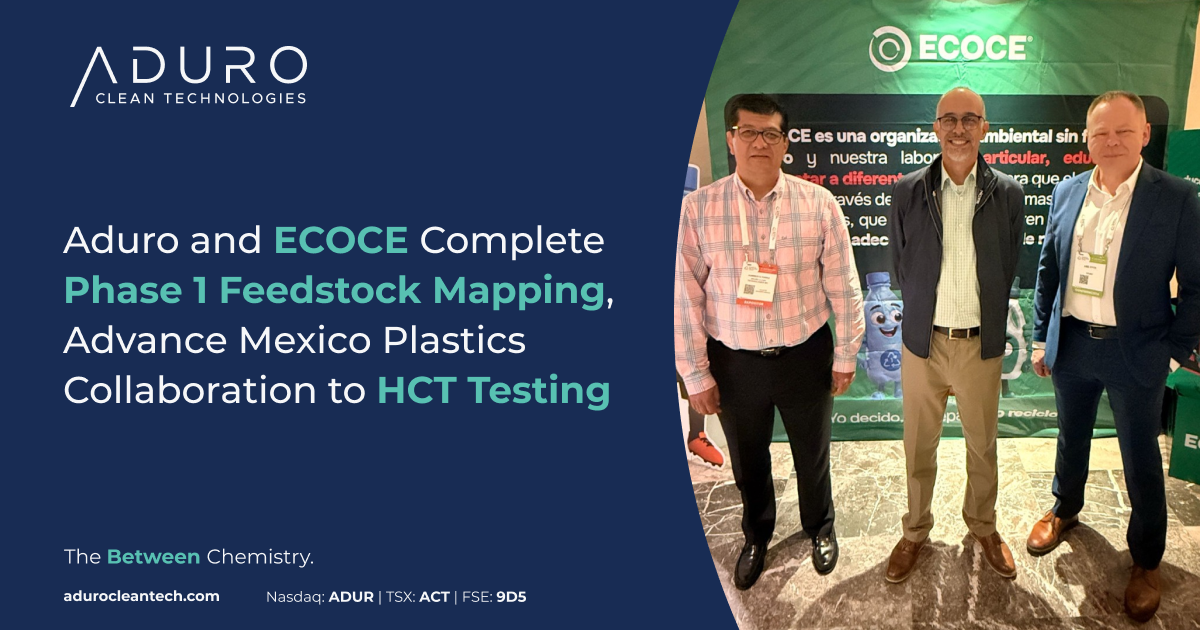
A photo accompanying this announcement is available at: https://www.globenewswire.com/NewsRoom/AttachmentNg/c6e45f47-4c07-4bdd-a9fa-758574558e87

Idag, 14:00
Selected streams from Mexico’s flexible and multilayer plastic waste, a category estimated at approximately 1.5 million tonnes annually, advance to HCT testing for circular feedstock evaluation
LONDON, Ontario, July 16, 2026 (GLOBE NEWSWIRE) -- Aduro Clean Technologies Inc. (“Aduro” or the “Company”) (Nasdaq: ADUR) (TSX: ACT) (FSE: 9D5), a clean technology company using the power of chemistry to transform lower-value feedstocks, like waste plastics, heavy bitumen, and renewable oils, into resources for the 21st century, today announced that its collaboration with ECOCE, A.C. (“ECOCE”) has advanced to the next phase following completion of Phase 1 feedstock mapping and stream selection. Selected post-consumer flexible plastic packaging streams in Mexico are now moving into a Hydrochemolytic™ Technology (“HCT”) test campaign to evaluate their conversion into liquid hydrocarbon products for downstream circular plastics applications.
The collaboration, announced in December 2025, is structured as a phased, data-driven evaluation of flexible plastic packaging collected through recovery systems in Mexico. Phase 1 drew on ECOCE’s ongoing national feedstock mapping program, conducted for its member companies, from which the parties completed the selection of candidate material streams for the next stage of work. Led by ECOCE, the mapping identified multiple post-consumer flexible packaging streams and assessed them for estimated availability, collection routes, physical form, contamination profile, and preparation requirements. The work identified candidate streams with sufficient available volume to support an industrially relevant evaluation and with material characteristics that warrant advancement to HCT testing.
Flexible plastic packaging is one of the most difficult material categories to manage within existing recycling systems. These streams can include polyethylene, polypropylene, and multilayer packaging formats, along with inks, adhesives, mixed structures, small formats, and varying levels of contamination. In line with the waste hierarchy, reduction, reuse, and mechanical recycling remain preferred options where they are technically and economically viable. For flexible packaging streams that are not well suited to mechanical or physical recycling, the collaboration is evaluating whether HCT can provide a route to recover hydrocarbon value from these materials and help return them to the plastics value chain.
ECOCE has identified flexible plastic packaging as a major and growing material category in Mexico, with available data indicating that approximately 1.5 million tonnes of flexible plastic packaging are generated annually in the country. Phase 1 has built on that market context by mapping candidate flexible and multilayer plastic packaging waste streams, including material categories, collection routes, geographic sourcing, and indicative contamination levels. The materials mapped through Phase 1 include flexible polypropylene packaging, flexible polyethylene packaging, and multilayer flexible packaging, including common post-consumer formats such as snack and cookie wrappers, grocery and bread bags, seed and grain packaging, pet food packaging, cold-cut and dairy packaging, and resealable pouch formats.
ECOCE’s work with leading food and beverage companies, representing more than 400 brands, gives the collaboration practical relevance to packaging value-chain priorities and the need for credible circularity options for difficult-to-recycle flexible packaging. The objective is to build an evidence-based understanding of how selected flexible packaging streams can move through a circular value chain: from post-consumer collection and characterization, through feedstock preparation and HCT conversion, to liquid hydrocarbon products for evaluation by petrochemical and polymer value chains.
With Phase 1 complete and the next-phase testing program defined, the collaboration now moves into HCT testing of selected material streams. Aduro will begin with lab-scale evaluation to assess how selected Mexican flexible and multilayer plastic waste streams respond to HCT, including processability, product characteristics, yield, residues, contaminant behaviour, and mass balance. As part of this next phase, Adrián Velasco, Director of Flexible Plastic Packaging at ECOCE, will visit Aduro facilities to review the testing pathway, sample requirements, and pilot-scale development program. The visit will help align ECOCE’s knowledge of recovery systems in Mexico with the Company’s technical evaluation process as selected streams move from feedstock mapping into HCT testing. Successful lab-scale results will inform progression to Phase 3 testing on the Next Generation Process (“NGP”) Pilot Plant to support scale-up assessment, customer evaluation, and future commercial analysis.
“Phase 1 has moved this collaboration from a market opportunity into a defined technical feedstock program,” said Ofer Vicus, CEO of Aduro. “ECOCE brings practical insight into how flexible packaging moves through Mexican recovery systems, helping us select representative material streams for HCT testing. The next phase will generate the data that matters for scale-up and economics, including processability, product quality, yield, contaminant behaviour, and the potential value of HCT-derived liquids as circular hydrocarbon feedstocks. This is how Aduro advances commercialization: by connecting real materials, downstream requirements, economic validation, and a clear pathway from lab testing to the NGP Pilot Plant.”
“Flexible plastic packaging is one of the most important material-management challenges in Mexico,” said Adrián Velasco, Director of Flexible Plastic Packaging at ECOCE. “Through this collaboration, ECOCE is helping connect real recovery-system data with the technical work needed to evaluate circular solutions for these materials. My visit to Aduro facilities as the collaboration moves into HCT testing will allow us to review the testing pathway directly, align on sample requirements, and better understand how selected Mexican flexible packaging streams could be evaluated for return to the plastics value chain.”
Results from the next phase will give Aduro and ECOCE the technical and economic evidence to help assess material suitability, product quality, scale-up requirements, and future commercial options for returning difficult-to-recycle flexible packaging to the plastics value chain.
About ECOCE
ECOCE, A.C. is a non-profit civil association in Mexico created and supported by the food and beverage industry to promote the proper management, collection, and recycling of post-consumer packaging waste. ECOCE brings together leading beverage and food companies, representing more than 400 brands, along with strategic allies working to advance circular economy practices for packaging in Mexico.
ECOCE works with industry, government, educational institutions, civil society, and citizens to strengthen recycling culture, support proper separation and recovery of packaging materials, and help direct post-consumer packaging into recycling systems. As ECOCE expands its focus from PET and other established material streams to flexible plastic packaging, it brings practical knowledge of Mexico recovery systems, packaging formats, collection infrastructure, and member-company circularity priorities. For further information, visit www.ecoce.mx.
About Aduro Clean Technologies
Aduro Clean Technologies is a developer of patented water-based technologies to chemically recycle waste plastics; convert heavy crude and bitumen into lighter, more valuable oil; and transform renewable oils into higher-value fuels or renewable chemicals. The Company’s Hydrochemolytic™ technology relies on water as a critical agent in a chemistry platform that operates at relatively low temperatures and cost, a game-changing approach that converts low-value feedstocks into resources for the 21st century. For further information, visit www.adurocleantech.com.
For further information, please contact:
Abe Dyck, Head of Corporate Development / Investor Relations
ir@adurocleantech.com
+1 226 784 8889
Carla Gamboa
Director of Marketing & Communications
cgamboa@ecoce.mx
Forward-Looking Statements
This news release contains forward-looking statements within the meaning of applicable Canadian and U.S. securities laws, including the U.S. Private Securities Litigation Reform Act of 1995. Forward-looking statements in this release include, but are not limited to: statements regarding the collaboration between Aduro and ECOCE; the characterization, selection, and evaluation of Mexican flexible plastic packaging streams; the potential application of Aduro Hydrochemolytic™ Technology to post-consumer flexible plastic packaging; the planned progression from lab-scale testing to potential Next Generation Process Pilot Plant trial runs; the potential generation of product-quality, mass-balance, scale-up, customer evaluation, technical, and commercial assessment data; market demand for circular feedstocks; the potential for HCT-derived hydrocarbon products to support petrochemical and polymer value chains; the potential development of business models or future HCT-based facilities in Mexico; and broader commercialization and market development plans.
Forward-looking statements are based on management current expectations and assumptions, including assumptions regarding: the availability, quality, composition, and suitability of feedstock streams; the ability of ECOCE to provide relevant feedstock information; the ability of Aduro to conduct staged technical testing; the performance of HCT across selected material streams; the scalability of results from lab-scale testing and NGP Pilot Plant operations; the availability of partners, customers, facilities, capital, and regulatory approvals; continued demand for circular feedstocks; and the stability of policy, market, and economic conditions supporting circular plastics. These statements are subject to a number of risks and uncertainties, including, but not limited to: the risk that selected materials may not be suitable for HCT processing; the risk that lab-scale or NGP Pilot Plant results may not support commercial application; the risk that product quality, yield, mass balance, or economics may not meet expectations; challenges in sourcing, preparing, shipping, or processing feedstock; delays in testing, analysis, contracting, permitting, financing, or partner engagement; changes in regulatory frameworks or market acceptance of circular feedstocks; competition from other recycling or waste-management pathways; risks related to the Company’s technology and intellectual property; risks related to market acceptance and commercialization; risks related to changes in laws, regulations, or policies; and other factors described in the Company’s public filings available at www.sedarplus.ca and on the SEC’s website at www.sec.gov. Actual results may differ materially from those expressed or implied by such forward-looking statements. Readers are cautioned not to place undue reliance on forward-looking statements. Except as required by law, Aduro undertakes no obligation to update or revise any forward-looking statements, whether as a result of new information, future events, or otherwise.
A photo accompanying this announcement is available at: https://www.globenewswire.com/NewsRoom/AttachmentNg/c6e45f47-4c07-4bdd-a9fa-758574558e87

Aktieanalys
Rapporter i urval
Rapporter i urval
USA och Asien
Aktieanalys
Rapporter i urval
Rapporter i urval
USA och Asien
1 DAG %
Senast
OMX Stockholm 30
−0,04%
(16:46)
Duni
Idag, 13:32
Duni: Finns det något som lockar?
Stockholmsbörsen
Idag, 13:31
Oregelbundet på börsen
OMX Stockholm 30
1 DAG %
Senast
3 149,41


-950x950.webp&w=3840&q=75)


