Closely Held Businesses Turn to Equity Plans as Noncompete Rules Tighten

Idag, 16:00
Idag, 16:00
Search Atlas / Key word(s): Financial
Closely Held Businesses Turn to Equity Plans as Noncompete Rules Tighten 10.11.2026 / 16:00 CET/CEST The issuer is solely responsible for the content of this announcement. By Connor Lacy, Partner, The McFarland Group OMAHA, NE - November 10, 2026 (NEWMEDIAWIRE) - Business owners who relied on noncompete agreements to protect their most valuable asset, their people, are rethinking that approach. The McFarland Group (TMG), an Omaha-based advisory firm for owners of closely held businesses, says companies are increasingly turning to well-designed equity compensation to keep and develop key employees. 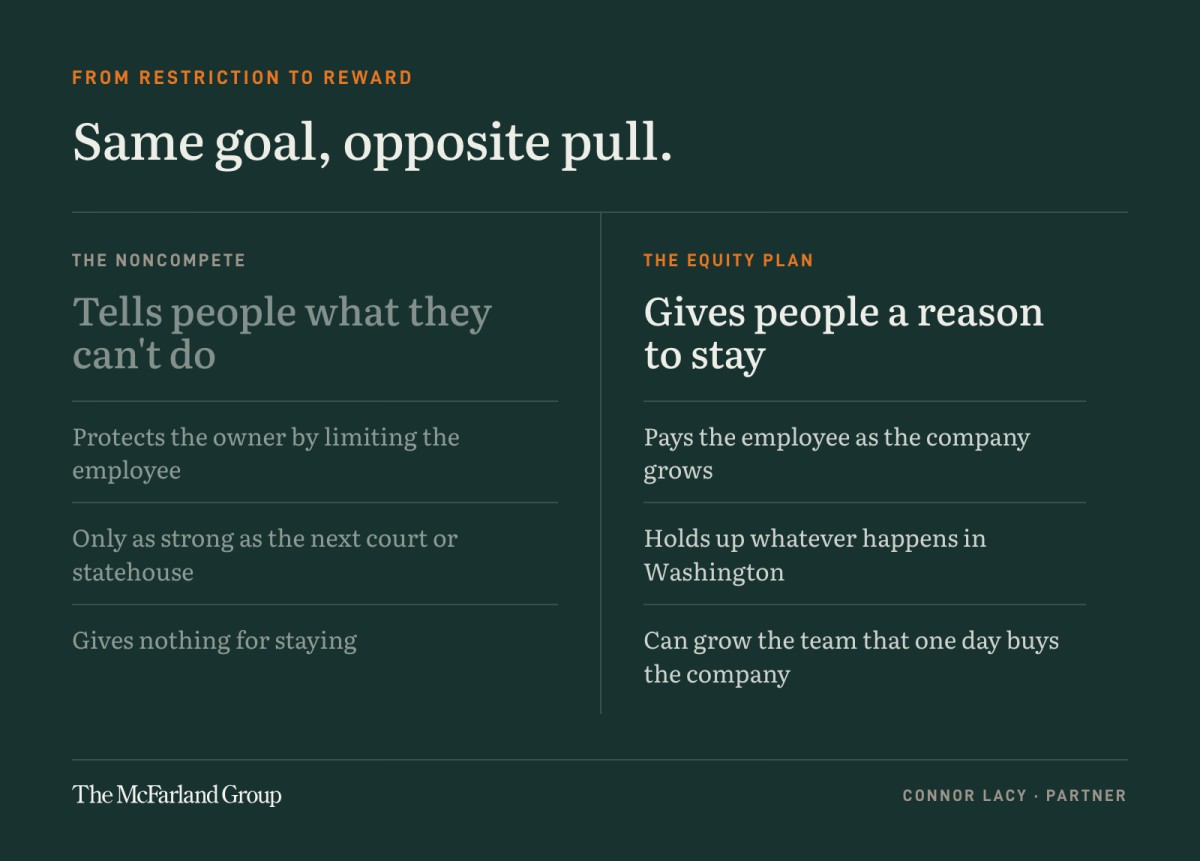 In 2024, the Federal Trade Commission issued a rule banning most noncompete agreements. A federal court set the rule aside that August. The FTC dropped its appeals in September 2025, and in February 2026 the rule was formally removed from federal regulations. The agency now challenges noncompetes case by case, and a growing number of states have restricted them on their own. The result: owners can no longer count on a signed noncompete to keep top talent from walking out the door, or from taking customers with them. "For years, many owners treated the noncompete as their retention strategy," said Connor Lacy of The McFarland Group. "But a noncompete only tells an employee what they can't do. A well-built equity plan gives them a reason to stay." From restriction to reward TMG is seeing clients redesign incentive plans to do the work noncompetes once did. Common approaches include:
"The owners getting this right are using equity to build a management team that thinks like owners," Lacy said. "In many cases, that team can eventually become the buyer." What owners should do now TMG recommends that business owners review existing employment agreements and incentive plans with qualified legal counsel, identify the employees whose departure would most affect company value, and consider whether their current compensation gives those people a meaningful stake in the company's future. "Regulation will keep changing," Lacy said. "A retention strategy built on shared value holds up whatever happens in Washington or the statehouse." Lacy writes more about the four plan designs, and the team that can become the buyer, at themcfarlandgroup.com/blog/noncompetes-equity-plans-next-owners. About The McFarland Group The McFarland Group is an advisory firm based in Omaha, Nebraska, founded by Byron McFarland. The firm has guided over $3 billion in business value through more than 200 ownership transitions over two decades. It works with owners of closely held businesses on M&A advisory, selling a business to management, and performance equity compensation for key leaders. The firm's guiding idea is simple: Go Boldly. Learn more at themcfarlandgroup.com. Media contact: Alex McFarland · admin@themcfarlandgroup.com · (402) 891-2300 · 4601 Catalyst Court, Suite 3055, Omaha, NE 68106
News Source: Search Atlas
10.11.2026 CET/CEST Dissemination of a Corporate News, transmitted by EQS News - a service of EQS Group.
The issuer is solely responsible for the content of this announcement.
The EQS Distribution Services include Regulatory Announcements, Financial/Corporate News and Press Releases.
|
Language: | English |
Company: | Search Atlas |
United States | |
EQS News ID: | 2432012 |
End of News | EQS News Service |
2432012 10.11.2026 CET/CEST
Idag, 16:00
Search Atlas / Key word(s): Financial
Closely Held Businesses Turn to Equity Plans as Noncompete Rules Tighten 10.11.2026 / 16:00 CET/CEST The issuer is solely responsible for the content of this announcement. By Connor Lacy, Partner, The McFarland Group OMAHA, NE - November 10, 2026 (NEWMEDIAWIRE) - Business owners who relied on noncompete agreements to protect their most valuable asset, their people, are rethinking that approach. The McFarland Group (TMG), an Omaha-based advisory firm for owners of closely held businesses, says companies are increasingly turning to well-designed equity compensation to keep and develop key employees. In 2024, the Federal Trade Commission issued a rule banning most noncompete agreements. A federal court set the rule aside that August. The FTC dropped its appeals in September 2025, and in February 2026 the rule was formally removed from federal regulations. The agency now challenges noncompetes case by case, and a growing number of states have restricted them on their own. The result: owners can no longer count on a signed noncompete to keep top talent from walking out the door, or from taking customers with them. "For years, many owners treated the noncompete as their retention strategy," said Connor Lacy of The McFarland Group. "But a noncompete only tells an employee what they can't do. A well-built equity plan gives them a reason to stay." From restriction to reward TMG is seeing clients redesign incentive plans to do the work noncompetes once did. Common approaches include:
"The owners getting this right are using equity to build a management team that thinks like owners," Lacy said. "In many cases, that team can eventually become the buyer." What owners should do now TMG recommends that business owners review existing employment agreements and incentive plans with qualified legal counsel, identify the employees whose departure would most affect company value, and consider whether their current compensation gives those people a meaningful stake in the company's future. "Regulation will keep changing," Lacy said. "A retention strategy built on shared value holds up whatever happens in Washington or the statehouse." Lacy writes more about the four plan designs, and the team that can become the buyer, at themcfarlandgroup.com/blog/noncompetes-equity-plans-next-owners. About The McFarland Group The McFarland Group is an advisory firm based in Omaha, Nebraska, founded by Byron McFarland. The firm has guided over $3 billion in business value through more than 200 ownership transitions over two decades. It works with owners of closely held businesses on M&A advisory, selling a business to management, and performance equity compensation for key leaders. The firm's guiding idea is simple: Go Boldly. Learn more at themcfarlandgroup.com. Media contact: Alex McFarland · admin@themcfarlandgroup.com · (402) 891-2300 · 4601 Catalyst Court, Suite 3055, Omaha, NE 68106
News Source: Search Atlas
10.11.2026 CET/CEST Dissemination of a Corporate News, transmitted by EQS News - a service of EQS Group.
The issuer is solely responsible for the content of this announcement.
The EQS Distribution Services include Regulatory Announcements, Financial/Corporate News and Press Releases.
|
Language: | English |
Company: | Search Atlas |
United States | |
EQS News ID: | 2432012 |
End of News | EQS News Service |
2432012 10.11.2026 CET/CEST
Anthropics IPO
Nvidia
Fonderna i teknikraset
Anthropics IPO
Nvidia
Fonderna i teknikraset
1 DAG %
Senast
OMX Stockholm 30
0,67%
(vid stängning)
USA
Idag, 15:44
Hegseth avfärdar krav på riksrätt
OMX Stockholm 30
1 DAG %
Senast
3 332,15


