Initial Field Work at Stöverfors and Kalvträsk Completed and Corporate Updates

Igår, 22:46
Igår, 22:46
Initial Field Work at Stöverfors and Kalvträsk Completed and Corporate Updates
Svea Mining completes first field program at Stöverfors and Kalvträsk propertiesand provides shareholder updates
Stockholm, November 6, 2026
Svea Mining AB (SVEA) ("Svea Mining" or the "Company") has completed its planned year 2026 field program at the Stöverfors and Kalvträsk gold projects in and next to the Skellefteå district of northern Sweden. The program consisted of three separate site visits in May, August and September months. At Stöverfors, two samples taken next to the main historical mining pit returned 16.4 and 9.58 grams per tonne (g/t) gold, thus confirming the high grades reported by the Swedish state exploration company in the early 1980s.At Kalvträsk, a sample from the assumed remains of a historical gold-bearing boulder returned 0.425 g/t gold and more than 1% arsenic, confirming gold-bearing mineralization on the property. The team also completed the first systematic till sampling of the permit. Field work at Kalvträsk is designed to trace the high-grade boulders found in the 1970s back to their source.
Stöverfors Highlights
•16.4 g/t gold in a sample from a rock heap next to the main historical pit
•Old mining pits from the late 1800s and early 1900s found at the reported locations
•Gold appears to follow a structure running north-northeast, with the best grades at its southern end close to the main pit
•Three old drill hole casings found; their numbering suggests at least four holes were drilled toward the high-grade vein
•A possible gold-bearing "quartzite unit" found at Gruvkläppen, about 1 km to the west from the main pit
•60 outcrop observations recorded; 19 rock chip and boulder samples now at the lab
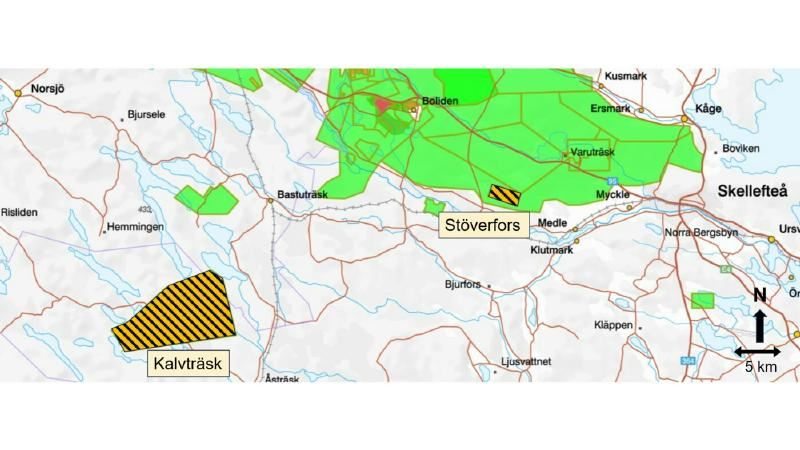
Figure 1. Location of the Stöverfors and Kalvträsk permits (hatched). Green areas show other exploration permits in the district.
A permit in one of Europe's great mining districts
Stöverfors lies in the Skellefteå district, a belt of copper, gold and zinc deposits about 130 km long and 30 km wide. It runs west-northwest from the city of Skellefteå. Boliden AB has mined here for more than 100 years. Its original Boliden mine averaged 15 g/t gold over 41 years of production. Five mines were operating in the district as of September 1, 2026, and exploration remains very active. The permit covers 452 hectares and is valid until June 25, 2029. Two unpaved roads cross it, making the area easy to reach.
History of the property
Artisanal gold mining has apparently taken place at Stöverfors in the late 1800s and early 1900s, when small pits were mined to recover quartz veins rich in arsenopyrite, a mineral associated with gold.
In the early 1980s, the Swedish state exploration company (SGAB) studied two areas on the property (report BRAP 82108):
•Stöverfors: Gold occurs in arsenopyrite-rich quartz veins that cut across the host rock. Samples from the veins returned 7.6 to 31.2 g/t gold.
•Gruvkläppen: About 1 km to the west, a gold-bearing, quartz-rich rock unit returned 0.4 to 1.8 g/t gold.
Svea Mining's goal for the year 2026 was to confirm the historical results and to better understand the geological framework and what controls the gold mineralisation.
Work completed
The team made three site visits:
•May 25: Located the historical pits at the reported locations and sampled the main pit quartz vein and waste rock, and the nearby host rock.
•August 5–6: Two days mapping and sampling the Stöverfors and Gruvkläppen areas. 22 samples were taken: 9 at Stöverfors, mostly from the old pits, and 13 at Gruvkläppen.
•September 18–21: Four days of detailed mapping at Stöverfors. The team recorded 60 outcrop observations, sent 14 rock chip samples and 5 boulder samples for assay, and used a portable XRF-analyser to screen samples on site.
May results
The May sample from the quartz-arsenopyrite rock heap beside the main pit (STO 2.O) returned 16.4 g/t gold, 1.01 g/t silver and more than 1% arsenic. Arsenic is a common marker for gold in this type of deposit. The other samples outside the vein returned low values. Selected assay results are below.
Sample | Gold (g/t) | Silver (g/t) | Arsenic (g/t) | Copper (g/t) |
STO 2.O | 16.4 | 1.01 | >10,000 | 33.1 |
STO 1.C | 0.088 | 0.14 | 5.4 | 51.9 |
STO 2.W | 0.027 | 0.09 | 439.4 | 20.8 |
STO 1.A | 0.015 | 0.08 | 50.3 | 23.9 |
STO 3 | 0.008 | 0.21 | 14.2 | 16.9 |
STO 1.B | <0.005 | 0.07 | 25.3 | 21.8 |
Table 1. May 2026 rock samples from Stöverfors. 10,000 g/t = 1%.
The high-grade vein structure takes shape
The field observations and assay results received to date, indicate a geological structure controlling the presence of the gold bearing quartz-arsenopyrite veins in Stöverfors. The structure is marked in Figure 2 with a red-black hatchet area running north-northeast direction. The highest grades, 16.4 g/t, 9.58 g/t and 0.93 g/t gold, sit at its southern end.
Gruvkläppen
In August, the team did not locate the gold-bearing outcrops reported in 1982, and the sampled zone of silicified metasediments with weak sulphide dissemination did not return gold. In September, the team found a new "quartzite unit" that may be the gold-bearing rock described in 1982, and it was sampled at three locations. The team also sampled four large boulders with varying degrees of silicification and disseminated sulphides. All assays are pending. The Gruvkläppen area is within the red circle in Figure 2.
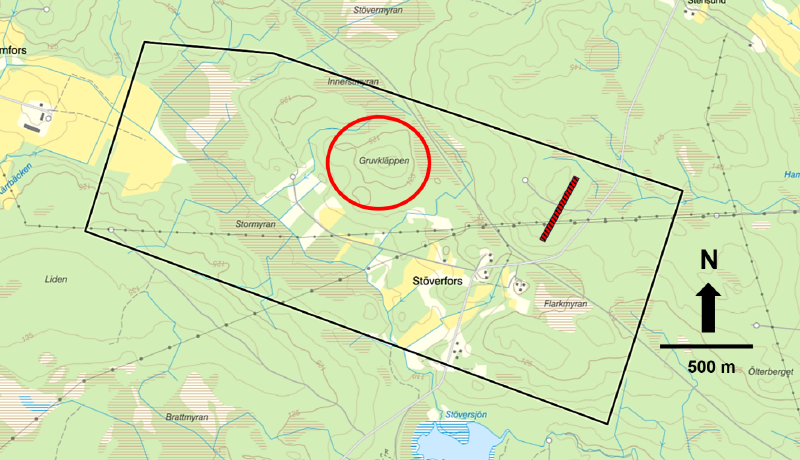
Figure 2. Stöverfors permit (black rectangle) and the identified prospective areas on red (see text above).
Next steps
The team has now a much better understanding of the geological framework at Stöverfors and coming exploration work will focus on following the high-grade gold-arsenopyrite vein structure, and on the “quartzite unit” at Gruvkläppen. Assay results from the September program will be released shortly after receival, and will guide the next phase of exploration.
"The results are very encouraging, as they confirm the high-grades reported in the 1980s and shows the potential to find more gold is real and finding old drill casings indicates that someone else saw this potential too. We now have a much clearer picture of where the gold sits, and we look forward to the September sampling results," says Jyri Meriläinen, Director and Professional Geologist at Svea Mining.
Laboratory methods
•May samples: Prepared by CRS Laboratories Oy in Finland and assayed by MSALABS in Canada. Gold was assayed by fire assay (methods FAS-111 and FAS-415). A further 48 elements were assayed by four-acid digestion with ICP-MS (method IMS-230).
•August samples: Assayed for gold by CRS Laboratories Oy using a cyanide leach method (PAL0.5kg-AAS), a fast, low-cost way to test for gold.
•September samples: Screened on site with a portable XRF-analyser and sent for laboratory assay at CRS Laboratories. Results are pending.
Sampling note
The samples reported here are grab samples. Grab samples are selected by hand and may not represent the average grade of the rock. Historical results come from public reports and have not been fully verified by the Company.
Kalvtrask Highlights
•Gold confirmed in a sample from the remains of a historical high-grade boulder
•31 till samples collected across the permit, with closer spacing around the historical boulders
•Each till site sampled twice: once for assay and once for a heavy mineral study that can detect gold grains
•38 outcrop observations, 5 rock samples and 8 boulder samples
•All samples are now at the CRS Laboratories
•Good road access across most of the 6,830-hectare permit
Between two major mining belts
Kalvträsk lies between two major mineral districts in Sweden, Skellefteå and Gold Line:
•The Skellefteå district to the north: a belt of copper, gold and zinc deposits about 130 km long, mined by Boliden AB for over 100 years. Five mines were operating there as of September 1, 2026.
•The Gold Line to the west: a gold-rich corridor about 200 km long and 30 km wide, with intense exploration and two past-producing gold mines, Svartliden and Blaiken.
The area between the two belts is considered under-explored given its geology. Kalvträsk sits in the Lappvattnet nickel-copper zone. The permit covers 6,830 hectares and is valid until September 3, 2029.
History of the property
In the late 1970s, the Swedish state exploration company (SGAB) found six mineralized boulders at Kalvträsk (report BRAP 81077):
•A large angular boulder of about 1.5 cubic meters returned 8 g/t gold
•A second angular boulder of about 0.5 cubic meters returned 13 g/t gold and 35 g/t silver
•Four smaller boulders returned up to 15 g/t gold, 1.06% copper and 2.4% zinc, along with silver
The source of these boulders has never been found. Very limited exploration activity in the area since.
Work completed
The team made three site visits:
•May 25: Visited the historical boulder sites. One sample was taken from what is believed to be the remains of the 1.5 cubic metre boulder.
•August 7: Verified road access and surveyed around the historical boulder sites. The roads were in good condition and cover most of the permit; only the road at Lappselsberget hill in the east was closed. Heavy rain limited the survey to the area around the two main boulder sites.
•September 22–26: Five days of mapping and sampling. The team recorded 38 outcrop observations and took 5 rock samples, 8 boulder samples and 31 till samples. A portable XRF analyser was used on site to screen samples.
May result
The sample from the historical boulder confirmed gold-bearing mineralization:
Sample | Gold (g/t) | Silver (g/t) | Arsenic (g/t) | Copper (g/t) |
KALV | 0.425 | 0.63 | >10,000 | 265 |
Table 2. May 2026 boulder sample from Kalvträsk. 10,000 g/t = 1%.
Tracing the boulders to their source
In northern Europe and Canada, glaciers eroded bedrock and deposited it farther away from the source bedrock as new soil (till), and larger fragments (boulders). Till and boulder sampling is a standard exploration method for locating mineralisations in bedrock.
The team planned 34 till sampling points across the Kalvträsk permit area (Fig. 3), with closer spacing around the historical boulder sites (points 6 and 10 in Fig. 3). Samples were collected at 31 of them. At each site, the team:
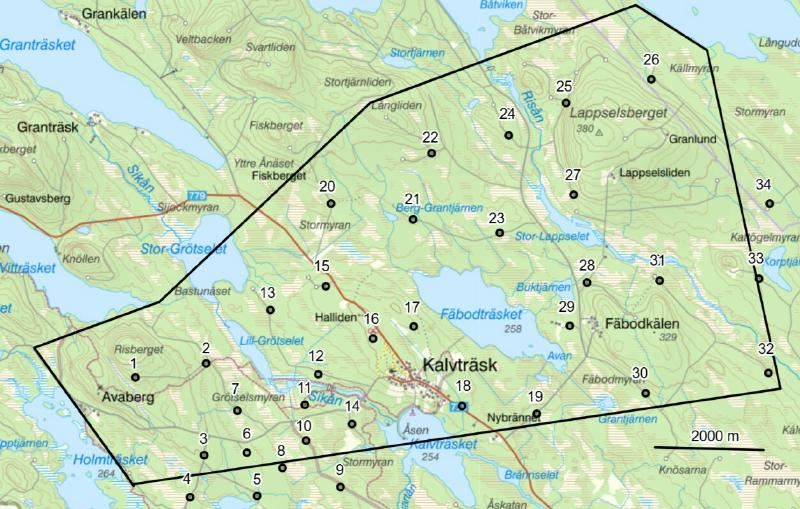
Figure 3. Kalvträsk permit area (black outline) and till sampling points (numbered dots). The historical boulders were found near points 6 and 10.
Results so far
The main rock types at Kalvträsk are a dark grey metasediment and granite, in outcrops, boulders and till. Apart from the May sample, the other historical boulders and gold-bearing rock types were not found during the program. Screening with the portable XRF did not show high arsenic or copper. Portable XRF cannot detect gold at these levels, so laboratory assays are needed.
Next steps
All rock, boulder and till samples are now at the lab. Results will be released when received and will guide the next phase of exploration at Kalvträsk.
"Finding the source of a boulder field is how many discoveries in northern Sweden have been made. This summer we built the base for that work at Kalvträsk. The till sampling covers the whole permit, and the heavy mineral samples will give us a more detailed understanding of the gold distribution in Kalvträsk area. We look forward to the results," says Jyri Meriläinen, Director and Professional Geologist at Svea Mining.
Laboratory methods
•May sample: Prepared by CRS Laboratories Oy in Finland and assayed by MSALABS in Canada. Gold was assayed by fire assay (methods FAS-111 and FAS-415). A further 48 elements were assayed by four-acid digestion with ICP-MS (method IMS-230).
•September samples: Screened on site with a portable XRF analyser and sent to CRS Laboratories for assay. Results are pending.
Sampling note
The rock and boulder samples reported here are grab samples. Grab samples are selected by hand and may not represent the average grade of the rock. Historical results come from public reports and have not been fully verified by the Company.
Qualified person
The technical information in this press release has been reviewed and approved by Jyri Meriläinen, M.Sc., EurGeol, a Director of Svea Mining. Mr. Meriläinen is a Competent Person as defined by the PERC Reporting Standard. He is not independent of the Company.
Shareholder Updates
Svea Mining AB: Change in major shareholdings
Sola Capital Corp. has sold shares in Svea Mining AB (publ). Its holding has fallen below 30 percent, decreasing from approximately 34.58 percent to approximately 28.99 percent of the shares and votes in the Company.
Giancarlo Jacob has sold shares in Svea Mining AB (publ). His holding has fallen below 20 percent, decreasing from approximately 20.20 percent to approximately 18.90 percent of the shares and votes in the Company.
This announcement is made in accordance with Spotlight Stock Market’s rules on the disclosure of major changes in holdings.
About Svea Mining AB
Svea Mining AB is a Swedish mineral exploration company exploring for gold, copper and silver across approximately 7,500 hectares in the Skellefteå volcanogenic massive sulphide (VMS) district of northern Sweden, one of Europe's most productive regions for gold, copper and silver for more than a century. The Company holds two exploration permits: the Kalvträsk project (approximately 7,000 hectares) and the Stöverfors project (451.93 hectares), both within or on the margin of a geological system that has produced almost 30 mines and still hosts active mining today. The Company's registered office is in Sweden.
For further information, please contact:
Ken Osborne, CEO, Svea Mining AB (publ)
Email: info@sveamining.com
Website: www.sveamining.com
Igår, 22:46
Initial Field Work at Stöverfors and Kalvträsk Completed and Corporate Updates
Svea Mining completes first field program at Stöverfors and Kalvträsk propertiesand provides shareholder updates
Stockholm, November 6, 2026
Svea Mining AB (SVEA) ("Svea Mining" or the "Company") has completed its planned year 2026 field program at the Stöverfors and Kalvträsk gold projects in and next to the Skellefteå district of northern Sweden. The program consisted of three separate site visits in May, August and September months. At Stöverfors, two samples taken next to the main historical mining pit returned 16.4 and 9.58 grams per tonne (g/t) gold, thus confirming the high grades reported by the Swedish state exploration company in the early 1980s.At Kalvträsk, a sample from the assumed remains of a historical gold-bearing boulder returned 0.425 g/t gold and more than 1% arsenic, confirming gold-bearing mineralization on the property. The team also completed the first systematic till sampling of the permit. Field work at Kalvträsk is designed to trace the high-grade boulders found in the 1970s back to their source.
Stöverfors Highlights
•16.4 g/t gold in a sample from a rock heap next to the main historical pit
•Old mining pits from the late 1800s and early 1900s found at the reported locations
•Gold appears to follow a structure running north-northeast, with the best grades at its southern end close to the main pit
•Three old drill hole casings found; their numbering suggests at least four holes were drilled toward the high-grade vein
•A possible gold-bearing "quartzite unit" found at Gruvkläppen, about 1 km to the west from the main pit
•60 outcrop observations recorded; 19 rock chip and boulder samples now at the lab
Figure 1. Location of the Stöverfors and Kalvträsk permits (hatched). Green areas show other exploration permits in the district.
A permit in one of Europe's great mining districts
Stöverfors lies in the Skellefteå district, a belt of copper, gold and zinc deposits about 130 km long and 30 km wide. It runs west-northwest from the city of Skellefteå. Boliden AB has mined here for more than 100 years. Its original Boliden mine averaged 15 g/t gold over 41 years of production. Five mines were operating in the district as of September 1, 2026, and exploration remains very active. The permit covers 452 hectares and is valid until June 25, 2029. Two unpaved roads cross it, making the area easy to reach.
History of the property
Artisanal gold mining has apparently taken place at Stöverfors in the late 1800s and early 1900s, when small pits were mined to recover quartz veins rich in arsenopyrite, a mineral associated with gold.
In the early 1980s, the Swedish state exploration company (SGAB) studied two areas on the property (report BRAP 82108):
•Stöverfors: Gold occurs in arsenopyrite-rich quartz veins that cut across the host rock. Samples from the veins returned 7.6 to 31.2 g/t gold.
•Gruvkläppen: About 1 km to the west, a gold-bearing, quartz-rich rock unit returned 0.4 to 1.8 g/t gold.
Svea Mining's goal for the year 2026 was to confirm the historical results and to better understand the geological framework and what controls the gold mineralisation.
Work completed
The team made three site visits:
•May 25: Located the historical pits at the reported locations and sampled the main pit quartz vein and waste rock, and the nearby host rock.
•August 5–6: Two days mapping and sampling the Stöverfors and Gruvkläppen areas. 22 samples were taken: 9 at Stöverfors, mostly from the old pits, and 13 at Gruvkläppen.
•September 18–21: Four days of detailed mapping at Stöverfors. The team recorded 60 outcrop observations, sent 14 rock chip samples and 5 boulder samples for assay, and used a portable XRF-analyser to screen samples on site.
May results
The May sample from the quartz-arsenopyrite rock heap beside the main pit (STO 2.O) returned 16.4 g/t gold, 1.01 g/t silver and more than 1% arsenic. Arsenic is a common marker for gold in this type of deposit. The other samples outside the vein returned low values. Selected assay results are below.
Sample | Gold (g/t) | Silver (g/t) | Arsenic (g/t) | Copper (g/t) |
STO 2.O | 16.4 | 1.01 | >10,000 | 33.1 |
STO 1.C | 0.088 | 0.14 | 5.4 | 51.9 |
STO 2.W | 0.027 | 0.09 | 439.4 | 20.8 |
STO 1.A | 0.015 | 0.08 | 50.3 | 23.9 |
STO 3 | 0.008 | 0.21 | 14.2 | 16.9 |
STO 1.B | <0.005 | 0.07 | 25.3 | 21.8 |
Table 1. May 2026 rock samples from Stöverfors. 10,000 g/t = 1%.
The high-grade vein structure takes shape
The field observations and assay results received to date, indicate a geological structure controlling the presence of the gold bearing quartz-arsenopyrite veins in Stöverfors. The structure is marked in Figure 2 with a red-black hatchet area running north-northeast direction. The highest grades, 16.4 g/t, 9.58 g/t and 0.93 g/t gold, sit at its southern end.
Gruvkläppen
In August, the team did not locate the gold-bearing outcrops reported in 1982, and the sampled zone of silicified metasediments with weak sulphide dissemination did not return gold. In September, the team found a new "quartzite unit" that may be the gold-bearing rock described in 1982, and it was sampled at three locations. The team also sampled four large boulders with varying degrees of silicification and disseminated sulphides. All assays are pending. The Gruvkläppen area is within the red circle in Figure 2.
Figure 2. Stöverfors permit (black rectangle) and the identified prospective areas on red (see text above).
Next steps
The team has now a much better understanding of the geological framework at Stöverfors and coming exploration work will focus on following the high-grade gold-arsenopyrite vein structure, and on the “quartzite unit” at Gruvkläppen. Assay results from the September program will be released shortly after receival, and will guide the next phase of exploration.
"The results are very encouraging, as they confirm the high-grades reported in the 1980s and shows the potential to find more gold is real and finding old drill casings indicates that someone else saw this potential too. We now have a much clearer picture of where the gold sits, and we look forward to the September sampling results," says Jyri Meriläinen, Director and Professional Geologist at Svea Mining.
Laboratory methods
•May samples: Prepared by CRS Laboratories Oy in Finland and assayed by MSALABS in Canada. Gold was assayed by fire assay (methods FAS-111 and FAS-415). A further 48 elements were assayed by four-acid digestion with ICP-MS (method IMS-230).
•August samples: Assayed for gold by CRS Laboratories Oy using a cyanide leach method (PAL0.5kg-AAS), a fast, low-cost way to test for gold.
•September samples: Screened on site with a portable XRF-analyser and sent for laboratory assay at CRS Laboratories. Results are pending.
Sampling note
The samples reported here are grab samples. Grab samples are selected by hand and may not represent the average grade of the rock. Historical results come from public reports and have not been fully verified by the Company.
Kalvtrask Highlights
•Gold confirmed in a sample from the remains of a historical high-grade boulder
•31 till samples collected across the permit, with closer spacing around the historical boulders
•Each till site sampled twice: once for assay and once for a heavy mineral study that can detect gold grains
•38 outcrop observations, 5 rock samples and 8 boulder samples
•All samples are now at the CRS Laboratories
•Good road access across most of the 6,830-hectare permit
Between two major mining belts
Kalvträsk lies between two major mineral districts in Sweden, Skellefteå and Gold Line:
•The Skellefteå district to the north: a belt of copper, gold and zinc deposits about 130 km long, mined by Boliden AB for over 100 years. Five mines were operating there as of September 1, 2026.
•The Gold Line to the west: a gold-rich corridor about 200 km long and 30 km wide, with intense exploration and two past-producing gold mines, Svartliden and Blaiken.
The area between the two belts is considered under-explored given its geology. Kalvträsk sits in the Lappvattnet nickel-copper zone. The permit covers 6,830 hectares and is valid until September 3, 2029.
History of the property
In the late 1970s, the Swedish state exploration company (SGAB) found six mineralized boulders at Kalvträsk (report BRAP 81077):
•A large angular boulder of about 1.5 cubic meters returned 8 g/t gold
•A second angular boulder of about 0.5 cubic meters returned 13 g/t gold and 35 g/t silver
•Four smaller boulders returned up to 15 g/t gold, 1.06% copper and 2.4% zinc, along with silver
The source of these boulders has never been found. Very limited exploration activity in the area since.
Work completed
The team made three site visits:
•May 25: Visited the historical boulder sites. One sample was taken from what is believed to be the remains of the 1.5 cubic metre boulder.
•August 7: Verified road access and surveyed around the historical boulder sites. The roads were in good condition and cover most of the permit; only the road at Lappselsberget hill in the east was closed. Heavy rain limited the survey to the area around the two main boulder sites.
•September 22–26: Five days of mapping and sampling. The team recorded 38 outcrop observations and took 5 rock samples, 8 boulder samples and 31 till samples. A portable XRF analyser was used on site to screen samples.
May result
The sample from the historical boulder confirmed gold-bearing mineralization:
Sample | Gold (g/t) | Silver (g/t) | Arsenic (g/t) | Copper (g/t) |
KALV | 0.425 | 0.63 | >10,000 | 265 |
Table 2. May 2026 boulder sample from Kalvträsk. 10,000 g/t = 1%.
Tracing the boulders to their source
In northern Europe and Canada, glaciers eroded bedrock and deposited it farther away from the source bedrock as new soil (till), and larger fragments (boulders). Till and boulder sampling is a standard exploration method for locating mineralisations in bedrock.
The team planned 34 till sampling points across the Kalvträsk permit area (Fig. 3), with closer spacing around the historical boulder sites (points 6 and 10 in Fig. 3). Samples were collected at 31 of them. At each site, the team:
Figure 3. Kalvträsk permit area (black outline) and till sampling points (numbered dots). The historical boulders were found near points 6 and 10.
Results so far
The main rock types at Kalvträsk are a dark grey metasediment and granite, in outcrops, boulders and till. Apart from the May sample, the other historical boulders and gold-bearing rock types were not found during the program. Screening with the portable XRF did not show high arsenic or copper. Portable XRF cannot detect gold at these levels, so laboratory assays are needed.
Next steps
All rock, boulder and till samples are now at the lab. Results will be released when received and will guide the next phase of exploration at Kalvträsk.
"Finding the source of a boulder field is how many discoveries in northern Sweden have been made. This summer we built the base for that work at Kalvträsk. The till sampling covers the whole permit, and the heavy mineral samples will give us a more detailed understanding of the gold distribution in Kalvträsk area. We look forward to the results," says Jyri Meriläinen, Director and Professional Geologist at Svea Mining.
Laboratory methods
•May sample: Prepared by CRS Laboratories Oy in Finland and assayed by MSALABS in Canada. Gold was assayed by fire assay (methods FAS-111 and FAS-415). A further 48 elements were assayed by four-acid digestion with ICP-MS (method IMS-230).
•September samples: Screened on site with a portable XRF analyser and sent to CRS Laboratories for assay. Results are pending.
Sampling note
The rock and boulder samples reported here are grab samples. Grab samples are selected by hand and may not represent the average grade of the rock. Historical results come from public reports and have not been fully verified by the Company.
Qualified person
The technical information in this press release has been reviewed and approved by Jyri Meriläinen, M.Sc., EurGeol, a Director of Svea Mining. Mr. Meriläinen is a Competent Person as defined by the PERC Reporting Standard. He is not independent of the Company.
Shareholder Updates
Svea Mining AB: Change in major shareholdings
Sola Capital Corp. has sold shares in Svea Mining AB (publ). Its holding has fallen below 30 percent, decreasing from approximately 34.58 percent to approximately 28.99 percent of the shares and votes in the Company.
Giancarlo Jacob has sold shares in Svea Mining AB (publ). His holding has fallen below 20 percent, decreasing from approximately 20.20 percent to approximately 18.90 percent of the shares and votes in the Company.
This announcement is made in accordance with Spotlight Stock Market’s rules on the disclosure of major changes in holdings.
About Svea Mining AB
Svea Mining AB is a Swedish mineral exploration company exploring for gold, copper and silver across approximately 7,500 hectares in the Skellefteå volcanogenic massive sulphide (VMS) district of northern Sweden, one of Europe's most productive regions for gold, copper and silver for more than a century. The Company holds two exploration permits: the Kalvträsk project (approximately 7,000 hectares) and the Stöverfors project (451.93 hectares), both within or on the margin of a geological system that has produced almost 30 mines and still hosts active mining today. The Company's registered office is in Sweden.
For further information, please contact:
Ken Osborne, CEO, Svea Mining AB (publ)
Email: info@sveamining.com
Website: www.sveamining.com
Techraset
Aktieanalyser
Investor
Techraset
Aktieanalyser
Investor
1 DAG %
Senast
OMX Stockholm 30
−1,01%
(vid stängning)
USA
Igår, 14:11
Uppgifter: USA och Iran närmar sig avtal
OMX Stockholm 30
1 DAG %
Senast
3 267,88


